Why Are 0 and 1 Not Prime Numbers? Clear Guide with Examples
Find out why neither 0 nor 1 counts as a prime number—explained with simple division examples, unique prime recipes, and a bit of math history.
Two questions pop up in almost every math classroom:
“Why isn’t 1 a prime number? It only divides by 1 and itself!” “And what about 0? Is 0 prime or composite?”
The short answer: neither 0 nor 1 is prime (and neither is composite, either).
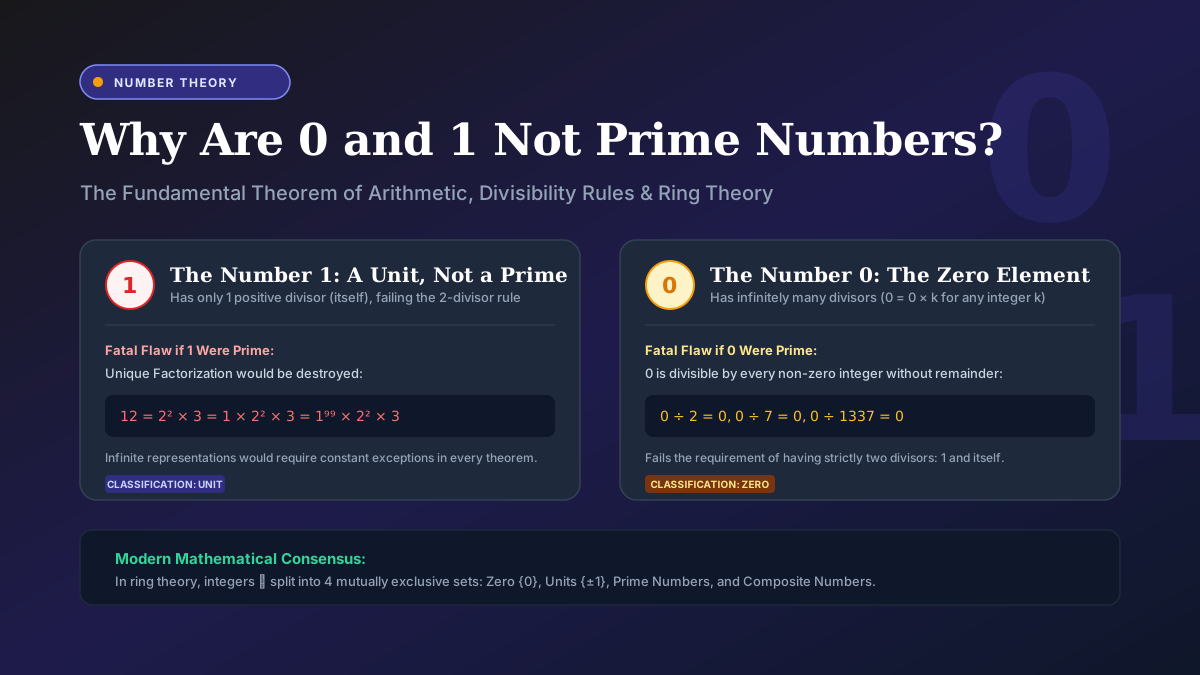
This isn’t a sneaky trick rule. Both 0 and 1 fail the exact rules of division and multiplication in completely opposite ways—one has too few factors, and the other has too many!
1. Two Simple Rules Every Prime Must Pass
To avoid any confusion, math uses a crystal-clear two-part definition:
Prime Rule: A whole number
pis prime only if:
- It is greater than 1 (
p > 1), AND- It has exactly two different positive factors:
1and itself.
Any whole number greater than 1 with three or more factors is called a composite number (4, 6, 8, 9, 10, 12, ...).
Right away, look at how both 1 and 0 break the rules:
- 1 has only one factor (
1itself)—not two different factors. - 0 has endless factors (
0 ÷ 2 = 0,0 ÷ 7 = 0,0 ÷ 999 = 0, with nothing left over!)—and it isn’t greater than 1.
2. Why 1 Isn’t Prime: Protecting Unique Prime Recipes
Every whole number bigger than 1 can be broken down into prime numbers multiplied together. Math experts call this the Unique Factorization rule, and you can think of it like a number’s secret fingerprint or prime recipe.
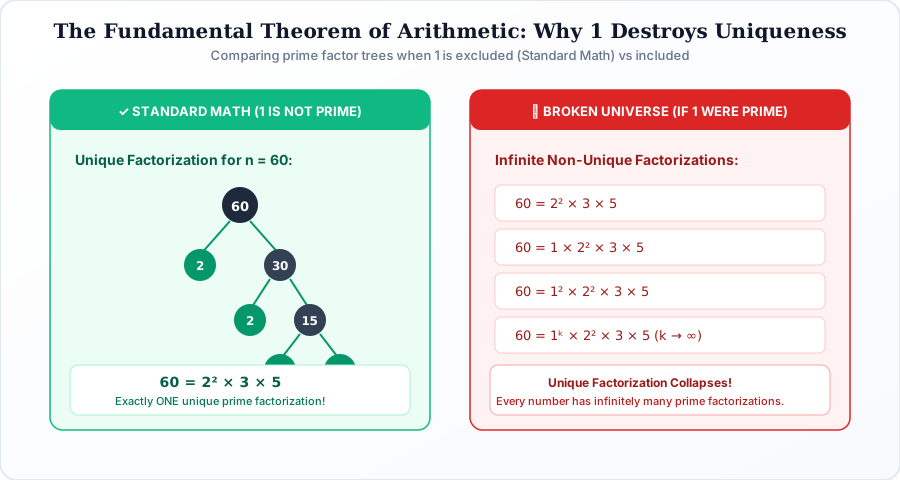
For 60, the prime recipe is:
60 = 2 × 2 × 3 × 5 (or 2² × 3 × 5)
No matter what order you split 60 on a factor tree, you will always end up with two 2s, one 3, and one 5.
What Happens If We Call 1 a Prime?
Suppose 1 counted as a prime number. Suddenly, 60 wouldn’t have one unique prime recipe anymore:
60 = 2² × 3 × 560 = 1 × 2² × 3 × 560 = 1² × 2² × 3 × 560 = 1⁹⁹⁹⁹ × 2² × 3 × 5
Because multiplying by 1 never changes an answer, you could keep sticking extra 1s onto any number forever!
Not only would unique recipes break—classic math formulas would break too:
- Divisor & Coprime Counters: Formulas that multiply across every prime factor of a number (
1 − 1/p) would hitp = 1, multiply by(1 − 1/1) = 0, and turn every answer into zero! - Every Math Proof: Textbooks would have to write “except for the prime number 1” at the bottom of almost every theorem.
Keeping 1 in its own special box (neither prime nor composite) keeps every math rule smooth and reliable.
3. Why 0 Isn’t Prime: Endless Factors & Broken Division
While 1 falls short by having only one factor, 0 fails in three different ways:
Reason 1: 0 Has Endless Factors
What does it mean for a to divide b evenly? It means you can write b = a × k for some whole number k.
Now plug in b = 0 and pick any non-zero whole number a:
0 = 2 × 0(so2divides0)0 = 7 × 0(so7divides0)0 = 1,000,000 × 0(so1,000,000divides0)
Instead of having just 2 factors like a prime number, every non-zero number divides evenly into 0! Wait—isn’t 0 even (0 = 2 × 0)? Yes, 0 is an even number, yet it still isn’t composite because composite numbers must be greater than 1 and made by multiplying smaller primes (and you can never multiply regular primes together to build 0!).
Reason 2: You Cannot Divide 0 by Itself
For every prime number p, dividing it by itself gives 1 (like 7 ÷ 7 = 1).
Try that with zero: 0 ÷ 0 has no valid answer because any number c satisfies 0 × c = 0. Division by zero breaks arithmetic.
Reason 3: Whole Numbers Have Four Separate Jobs
In modern math, whole numbers sit in four clear groups based on how they behave:
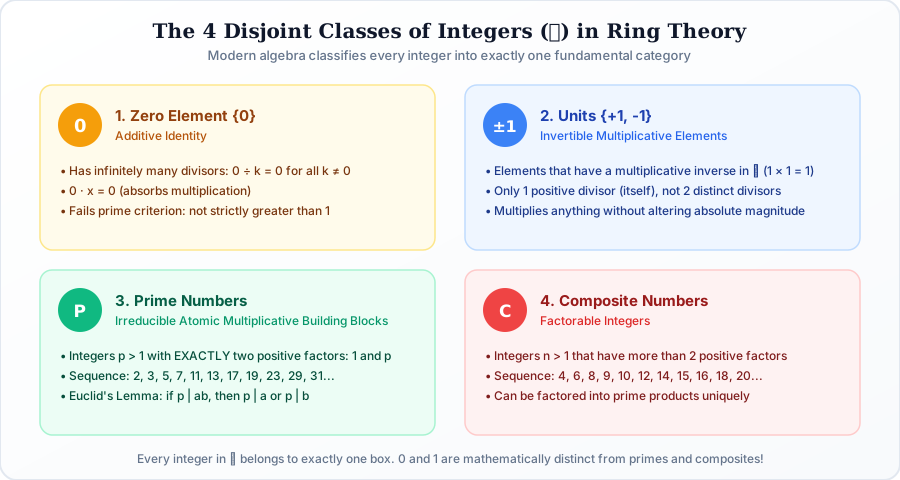
- Zero (
0): Adding zero leaves a number unchanged (x + 0 = x); multiplying by zero wipes everything out (x × 0 = 0). - Starters / Units (
1and−1): Multiplying by1leaves numbers unchanged (x × 1 = x). - Primes (
2, 3, 5, 7, ...): The building blocks that cannot break down further. - Composites (
4, 6, 8, 9, ...): Numbers built by multiplying two or more primes together.
Calling 0 or 1 prime would be like sorting a rest note or a blank page into the alphabet—they do a completely different job!
4. A Quick Look Back in History
People didn’t always agree on 1 right away:
- Ancient Greece (c. 300 BCE): Euclid treated
1as the basic unit used to measure numbers—not a “collection of units”—so Greeks started numbers at2, making 2 their first prime. - 1700s to early 1900s: Some mathematicians temporarily included
1in prime lists. Even Christian Goldbach counted1as prime in his famous 1742 letter to Leonhard Euler, and Lehmer’s big printed list in 1914 opened with1. - Today’s Standard (since the 1930s): Once modern algebra proved how clean math becomes when
1is excluded, every school book, calculator, and math encyclopedia agreed: primes start at 2.
5. Frequently Asked Questions
How should I label 0 and 1 on a math worksheet?
- 0: Even number, neither prime nor composite.
- 1: Odd number (a starter/unit), neither prime nor composite.
Is 2 a prime number?
Yes! 2 is the smallest prime number and the only even prime, because its only positive factors are 1 and 2.
Does Goldbach’s famous sum rule still work without 1?
Yes! The modern version says: “Every even number bigger than 2 can be written as two primes added together.”
4 = 2 + 26 = 3 + 38 = 3 + 510 = 3 + 7 = 5 + 5
Try Our Interactive Tools
- Browse primes cleanly from 1 to 1,000: Prime Numbers List
- Check any number right now: Prime Number Calculator
- Build step-by-step factor trees: Factor Tree Calculator
- See if two numbers share factors: Coprime Calculator
Want to check a prime number right now?
Our free online calculator checks numbers up to 18 quintillion with 100% accuracy, giving you instant factor trees and clear step-by-step reasons.
Written in plain, friendly English and checked against trusted math research and automated tests.