Prime Counting Calculator
Find out exactly how many prime numbers exist up to any limit x (written as π(x)). Watch how primes build up like steps on a staircase, and compare real counts against famous math formulas.
| Method | Formula | Estimated Count | Accuracy Difference |
|---|---|---|---|
| Exact Count π(x) | True counted total | 168 | Exact Match (0.00%) |
| Gauss Formula (Li) | Curved integral sum Li(x) | 178 | +5.95% |
| Simple Estimate | x / ln(x) | 145 | -13.69% |
1. The Prime Staircase: Watching Prime Counts Step Up
Prime counts grow like a staircase. Every time you land on a prime number, the total jumps up by +1 step. Across composite numbers, the count stays completely flat. Move the slider to watch the staircase climb up to 30:
2. Counting Primes Without Checking Every Number (Legendre's Shortcut)
In 1798, French mathematician Adrien-Marie Legendre showed that you don't have to check every number to find how many primes exist. You only need to filter out multiples of the small primes up to the square root of your number. Use this interactive solver to see how filtering multiples reveals the exact count:
3. How Primes Thin Out from 10 to 1 Billion
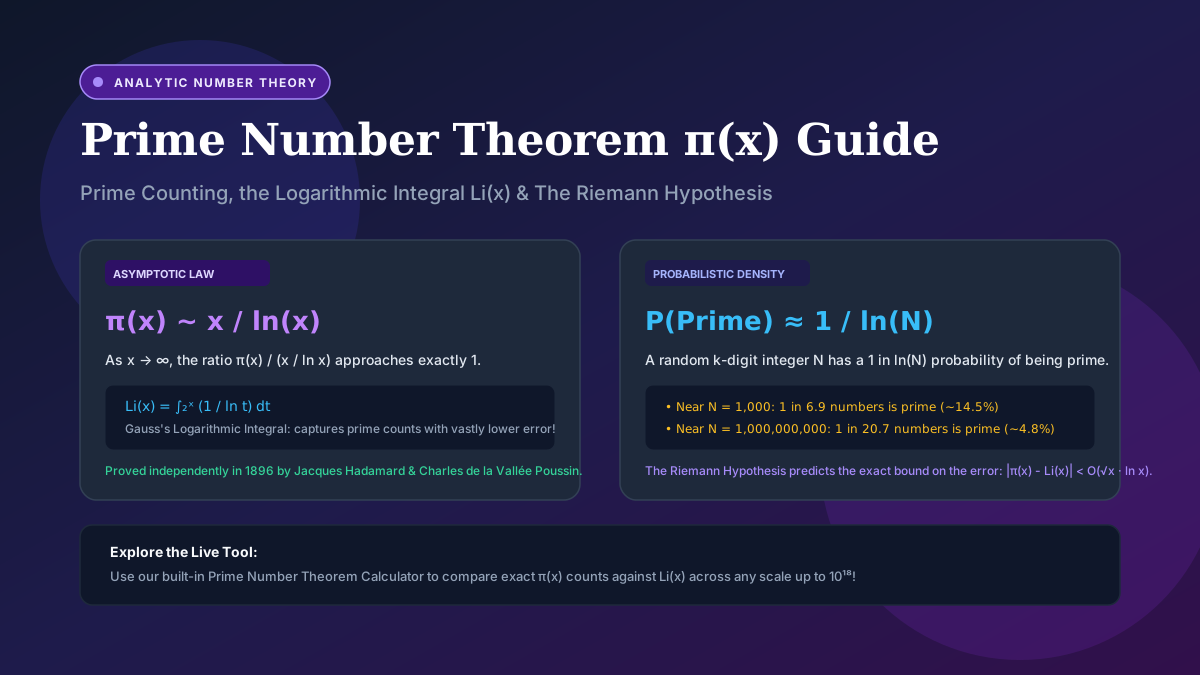
While prime numbers go on forever, they become less and less frequent as numbers get larger. Click any power of 10 to see its exact prime count and how the percentage drops:
Known since ancient times: 2, 3, 5, and 7. Exactly 4 out of every 10 numbers are prime.
4. Landmark Counts & Accuracy Table
See the exact prime counts compared with Gauss's formula Li(x) and simple estimate x / ln(x). Click any row to test it in the calculator above:
| Up to (x) | Exact Count | Gauss Li(x) | Simple x/ln(x) | Gauss Error | Try It |
|---|---|---|---|---|---|
| 10 | 4 | 6 | 4 | +50.0% | |
| 25 | 9 | 11 | 8 | +22.2% | |
| 50 | 15 | 18 | 13 | +20.0% | |
| 100 | 25 | 30 | 22 | +20.0% | |
| 200 | 46 | 52 | 38 | +13.0% | |
| 500 | 95 | 103 | 80 | +8.42% | |
| 1,000 | 168 | 178 | 145 | +5.95% | |
| 2,000 | 303 | 316 | 263 | +4.29% | |
| 5,000 | 669 | 687 | 587 | +2.69% | |
| 10,000 | 1,229 | 1,246 | 1,086 | +1.38% | |
| 25,000 | 2,762 | 2,787 | 2,469 | +0.91% | |
| 50,000 | 5,133 | 5,166 | 4,621 | +0.64% | |
| 100,000 | 9,592 | 9,630 | 8,686 | +0.40% | |
| 250,000 | 22,044 | 22,096 | 20,114 | +0.24% | |
| 500,000 | 41,538 | 41,606 | 38,103 | +0.16% | |
| 1,000,000 | 78,498 | 78,628 | 72,382 | +0.17% | |
| 10,000,000 | 664,579 | 664,918 | 620,421 | +0.05% | |
| 100,000,000 | 5,761,455 | 5,762,209 | 5,428,681 | +0.01% | |
| 1,000,000,000 | 50,847,534 | 50,849,235 | 48,254,942 | +0.003% | |
| 10,000,000,000 | 455,052,511 | 455,055,615 | 434,294,482 | +0.001% |
5. Four Clear Walkthroughs
Walk through four examples showing how prime counts are calculated across different ranges:
Numbers checked: 1 through 10.
Which ones are prime: 1 is neither prime nor composite; 2, 3, 5, 7 have no other factors; 4, 6, 8, 9, 10 are composite.
Result: Exactly 4 primes (2, 3, 5, 7). 4 out of 10 = 40% are prime.
Shortcut rule: Square root of 100 is 10. The only primes up to 10 are 2, 3, 5, and 7.
Filtering multiples: Removing multiples of 2, 3, 5, and 7 leaves 22 numbers.
Adding the filter primes: Adding the 4 filter primes back (and subtracting 1) gives exactly 25 primes.
Exact count: There are exactly 168 primes up to 1,000 (the 168th prime is 997).
Simple estimate: 1,000 / ln(1,000) ≈ 145 (underestimates by about 14%).
Gauss formula Li(1,000): Predicts 178 primes (only off by 10 primes, an error of under 6%).
Guaranteed range: Mathematicians proved the count must be between 1,218 and 1,233.
Exact count: Exactly 1,229 primes exist up to 10,000, landing safely inside the predicted window.
Density: 1,229 out of 10,000 means about 12.3% of numbers are prime.
6. How Computers Count Primes Up to Trillions
How do supercomputers count primes up to 10²&sup8; when checking every number would take millions of years? Mathematicians invented smart grouping shortcuts that count primes in large batches:
| Method | Speed | Memory Needed | Practical Limit |
|---|---|---|---|
| Sieve Grid (Checking All) | Slow for huge numbers | Huge memory | Up to 100 billion |
| Legendre Filter | Moderate | Small memory | Up to 1 trillion |
| Meissel-Lehmer Shortcut | Extremely Fast | Very low memory | Up to 10 sextillion |
| Gourdon Modern Method | World Record Speed | Optimized clusters | Up to 10²⁹ (Current world record) |
7. The Skewes' Number Mystery: Does the Formula Always Overestimate?
For every number humans have ever tested on computers, Gauss's formula Li(x) predicts slightly more primes than actually exist. In 1914, mathematician J. E. Littlewood stunned mathematicians by proving that the real prime count actually crosses above the formula infinitely many times!
1933 (Stanley Skewes): Calculated that the crossover happens before an enormous number: 10^(10^(10^34)).
1955 (Skewes' general bound): Proved a crossover before 10^(10^(10^964)), famous as one of the largest numbers ever used in a mathematical proof.
2014 (Modern computers): Narrowed down the first crossover to approximately 1.397 × 10³¹⁶ (a 1 followed by 316 zeros).
Related Prime Discovery Tools
Frequently Asked Questions
What is the prime counting function π(x)?
The prime counting function, written with the Greek letter pi as π(x), simply counts how many prime numbers exist up to a number x. In this context, π is just a math label (short for 'prime'), not the number 3.14159. For example, π(10) = 4 because there are four primes up to 10: 2, 3, 5, and 7.
Does π(x) count x if x is itself a prime number?
Yes, π(x) includes x itself. For example, since 97 is prime, π(97) counts 97, giving a total of 25 primes. But for 96 (which is composite), π(96) is 24.
What is the difference between the exact count and formula estimates?
The exact count π(x) is found by actually counting every prime. For huge numbers where counting every prime takes too long, formulas like Gauss's Li(x) and x / ln(x) provide remarkably accurate estimates without checking every number one by one.
How many prime numbers are there up to 100, 1,000, and 1,000,000?
There are exactly 25 primes up to 100 (25% of all numbers), exactly 168 primes up to 1,000 (16.8%), and exactly 78,498 primes up to 1,000,000 (about 7.8%).
How can computers count primes up to 10²⁸ without checking every number?
Checking numbers one by one for a 28-digit number would take billions of years. Instead, mathematicians use clever shortcut formulas (like the Meissel-Lehmer method) that count primes in groups using patterns of common multiples, finding the exact count in minutes.
Does Gauss's formula Li(x) always overestimate the prime count?
For every number humans have ever tested on computers, Gauss's formula Li(x) predicts slightly more primes than actually exist. But in 1914, mathematician J. E. Littlewood proved that if you go far enough out (past mind-bogglingly huge numbers like Skewes' number), the real count actually catches up and passes the formula infinitely many times!
What is Legendre's shortcut for counting primes?
In 1798, French mathematician Adrien-Marie Legendre showed that you only need to know the primes up to the square root of a number to find the total prime count. By subtracting multiples of 2, 3, 5, etc., and adding back overlapping numbers, you get the exact prime count without testing every single number.
Why do primes become less frequent as numbers get bigger?
As numbers get larger, there are more small prime numbers below them that can potentially divide into them. For example, 40% of numbers under 10 are prime, but only about 5% of numbers around 1 billion are prime.