Why 1 Is Not a Prime Number: Simple Explanation & History
Why does every math book say 1 is not a prime number? Learn the two-factor rule, what breaks if 1 counts as prime, and how mathematicians settled the debate.
At first glance, “Is 1 a prime number?” sounds like an easy “yes.” After all, most of us first learn in elementary school that a prime number is:
“A number that can only be divided evenly by 1 and itself.”
Because 1 ÷ 1 = 1, 1 seems to fit! Yet every modern textbook, teacher, and calculator insists that 1 is NOT a prime number.
Why? It isn’t a trick or a picky rule for no reason. Here is the plain-English explanation of why 1 gets its own special spot, what would go wrong if 1 were called prime, and why people actually used to argue about it.
1. The Hidden Catch in the Elementary School Rule
The simple rule taught to kids—“a number divisible only by 1 and itself”—quietly assumes something important: that “1” and “itself” are two different numbers.
When mathematicians write down the official rule carefully, they include that missing detail:
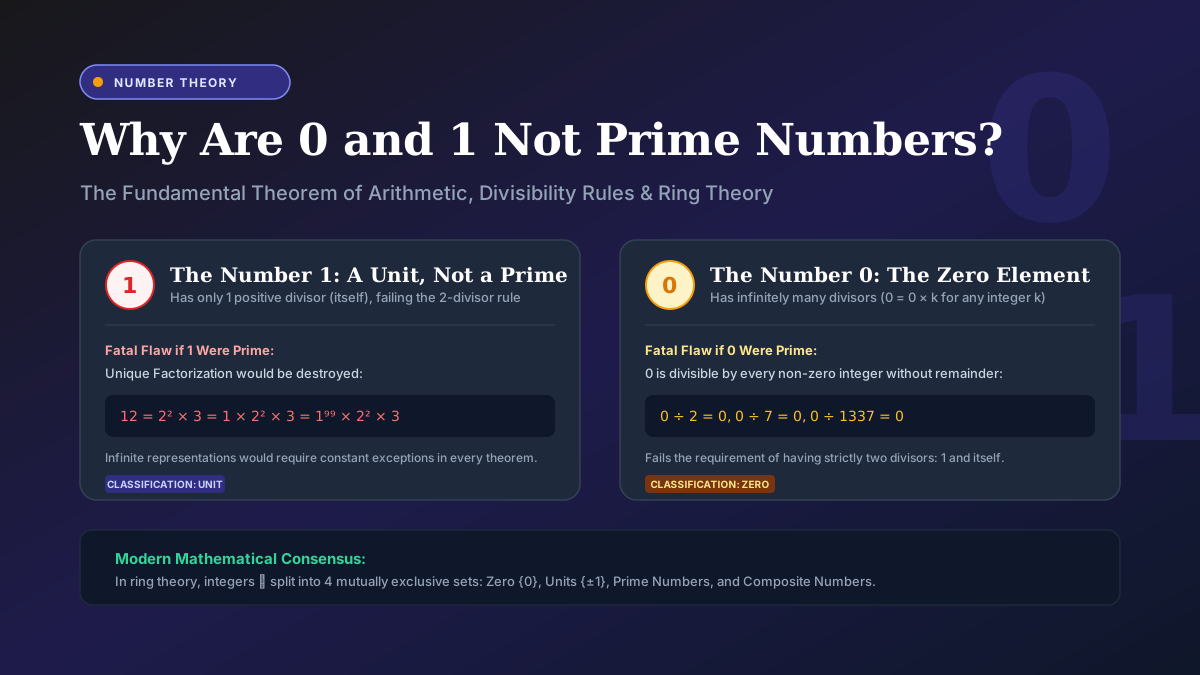
The Exact Rule: A prime number is a whole number greater than 1 that has exactly two different positive factors (
1and itself).
Count the whole-number factors of the first few numbers:
- Number 1: Only
1divides it evenly → 1 factor total. - Number 2: Divides by
1and2→ 2 factors total → Prime! - Number 3: Divides by
1and3→ 2 factors total → Prime! - Number 4: Divides by
1, 2,and4→ 3 factors total → Composite!
Because 1 only has one factor instead of two, it fails the rule. It sits in its own starter category: neither prime nor composite.
2. The Main Reason: Every Number Needs One Unique Prime Recipe
Think of prime numbers as the LEGO bricks (or chemical atoms) of math. Just as a water molecule (H₂O) is always built from two hydrogen atoms and one oxygen atom, every composite number has one unique prime recipe made by multiplying primes together:
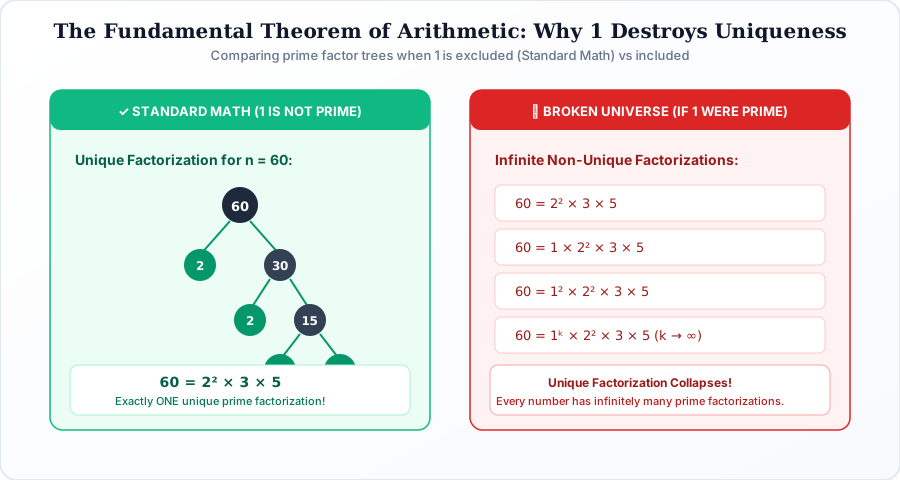
12 = 2 × 2 × 3360 = 2 × 2 × 2 × 3 × 3 × 5
Math relies heavily on the Unique Prime Factorization rule: there is only one combination of prime numbers that multiplies together to build 360 (ignoring order).
What Breaks If 1 Counts as Prime?
Now pretend we changed the rules and called 1 a prime number. Look what happens to the “prime recipe” of 12:
12 = 2 × 2 × 312 = 1 × 2 × 2 × 312 = 1 × 1 × 2 × 2 × 312 = 1 × 1 × 1 × ... × 1 × 2 × 2 × 3
Because multiplying by 1 changes nothing (1 × x = x), you could tack on as many 1s as you wanted forever! Suddenly 12 wouldn’t have one prime recipe—it would have endless prime recipes.
If 1 were prime, almost every rule in math would need an annoying warning label attached:
“Every whole number has one unique prime recipe… except please ignore the prime number 1.”
Leaving 1 out makes all the math rules clean, simple, and free of annoying exceptions.
3. How Whole Numbers Sort into Four Clean Groups
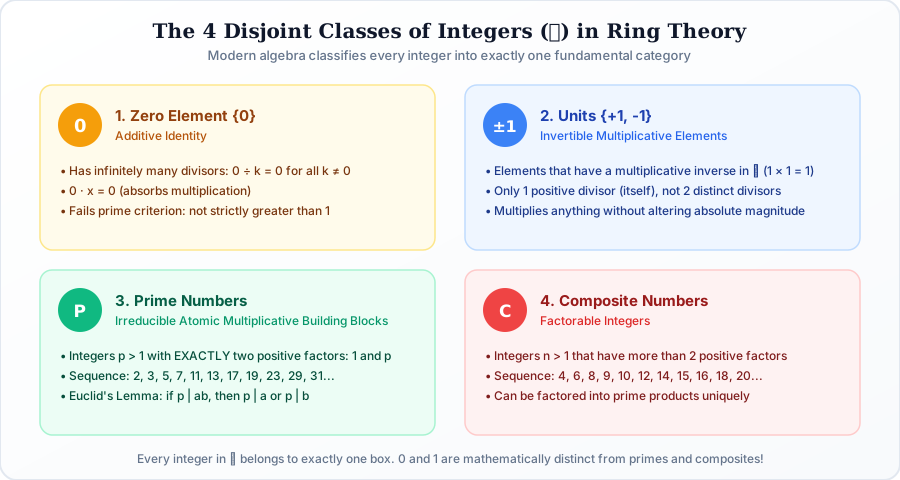
To keep everything tidy, mathematicians sort whole numbers into four distinct groups:
- Zero (
0): The empty / nothing number (x + 0 = x, and0 × x = 0). - Neutral Starters (
1and−1): Multiplying by1leaves any number untouched (1 × 7 = 7). Math books often call1a “unit.” - Prime Numbers (
2, 3, 5, 7, ...): The basic building blocks that cannot be split any smaller. - Composite Numbers (
4, 6, 8, 9, ...): Bigger numbers built by multiplying two or more primes together.
Calling 1 a prime would mix up the neutral starter (1) with the building blocks (2, 3, 5, ...).
4. Did People Ever Think 1 Was Prime?
Yes! The rule took centuries to settle:
Ancient Greece (Around 300 BCE)
Euclid’s famous math books treated 1 as the measuring stick used to count everything else—so the ancient Greeks didn’t even count 1 as a regular number! For them, counting numbers started at 2, and 2 was always the first prime.
The 1700s to Early 1900s
Later on, opinions split. Several famous mathematicians actually wrote 1 at the top of their prime charts! In 1742, Christian Goldbach included 1 in his famous letter about adding two primes (2 = 1 + 1), and Derrick Norman Lehmer’s big printed table of primes from 1914 famously started with 1.
Modern Agreement (Mid-1900s)
As algebra grew more organized in the early 1900s, mathematicians everywhere agreed that keeping 1 separate made every proof and formula cleaner. Since the 1930s and 1940s, every textbook and curriculum agrees: prime numbers start at 2.
5. Quick Side-by-Side Comparison
| Feature | The Number 1 | A Prime Number (2, 3, 5) |
A Composite Number (4, 6, 8) |
|---|---|---|---|
| Positive Factors | Only 1 (1) |
Exactly 2 (1 and itself) |
3 or more |
| Role in Math | Neutral starter (multiplication stays unchanged) | Basic building block | Built by multiplying primes |
| Prime Recipe | None (before building starts) | Just itself (p) |
Primes multiplied together (12 = 2² × 3) |
| Category | Neither Prime nor Composite | Prime | Composite |
Quick Questions & Answers
Is 1 a composite number instead?
No. A composite number must be greater than 1 and have at least three factors. Because 1 only has one factor (1), it is neither prime nor composite.
What is the only even prime number?
2 is the only even prime. Every other even number (4, 6, 8, 10, ...) divides evenly by 2, giving it at least three factors.
Can negative numbers like -1 or -5 be prime?
No. In everyday math and schoolwork, prime numbers are always positive whole numbers greater than 1.
Tools to Explore
- Check any number with step-by-step reasons: Prime Number Calculator
- Build factor trees for any number: Factor Tree Calculator
- See if two numbers share any factors: Coprime Calculator
- Count primes up to any limit: Prime Counting Calculator
Want to check a prime number right now?
Our free online calculator checks numbers up to 18 quintillion with 100% accuracy, giving you instant factor trees and clear step-by-step reasons.
Written in plain, friendly English and checked against trusted math research and automated tests.