How Many Primes Are There? The Prime Counting Guide
See how prime numbers thin out smoothly as numbers grow larger, why x / ln(x) and Gauss's curve predict prime counts so accurately, and the million-dollar mystery behind their spacing.
Up close, prime numbers look unpredictable. Sometimes two primes sit side by side (11 and 13). Other times they vanish for hundreds of steps—for example, after 142,517,282,443,770,048,841, there is a gap of 1,475 composite numbers in a row without a single prime!
Yet when you zoom out and look at thousands, millions, or billions of numbers at once, that messy randomness melts into a surprisingly smooth, predictable curve.
That hidden big-picture pattern is called the Prime Number Theorem.
1. Counting Primes Up to a Limit: π(x)
To track how common primes are, math writers use a short label written π(x)—meaning “how many prime numbers are less than or equal to x.”
(Don’t mix this up with π ≈ 3.14159 for circles! Here π(x) simply stands for “prime count up to x.”)
Watch how π(x) climbs at powers of 10:
- Up to
10:4primes (2, 3, 5, 7) - Up to
100:25primes - Up to
1,000:168primes - Up to
10,000:1,229primes - Up to
100,000:9,592primes - Up to
1,000,000:78,498primes
Every time you hit a prime, π(x) steps up by 1; everywhere else it stays flat like a staircase.
2. The Teenage Discovery Behind the Prime Estimate
Back in 1792, a 15-year-old German math genius named Carl Friedrich Gauss loved browsing printed books of prime tables. Notice what caught his eye: as numbers got 10 times bigger, primes appeared noticeably further apart—at a remarkably steady pace!
Around a number x, the average spacing between back-to-back primes is roughly ln(x) (the natural logarithm of x, which grows by about 2.3 every time you add one extra digit).
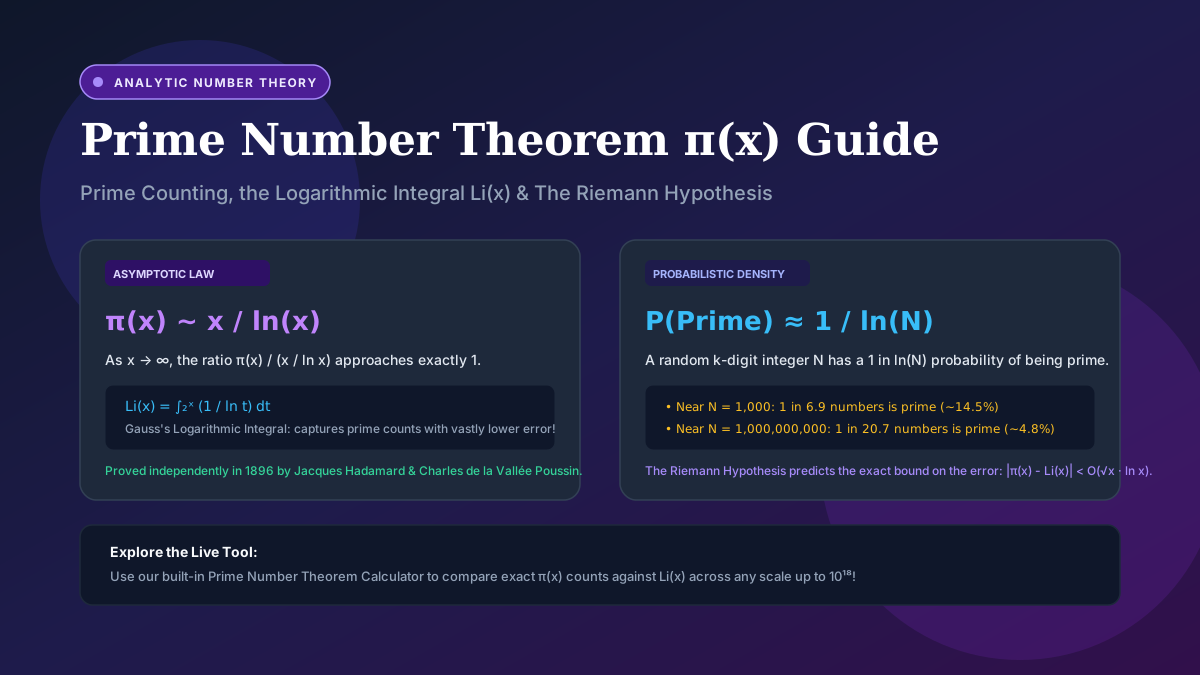
That gives the famous Prime Number Theorem estimate:
Estimated primes up to x ≈ x / ln(x)
In plain English: as x grows huge, the real prime count π(x) and the simple fraction x / ln(x) match closer and closer in percentage terms—until their ratio approaches 100% agreement (1.0).
(More than a hundred years later, in 1896, two mathematicians—Jacques Hadamard and Charles Jean de la Vallée Poussin—finally proved Gauss’s guess was 100% true forever.)
3. Why Gauss’s Smooth Curve Li(x) Is Even Closer
While x / ln(x) gets the big trend right, it noticeably undercounts primes for everyday sizes like thousands or millions.
Gauss noticed an even sharper way to estimate. Think of 1 / ln(t) as the chance that a number near t happens to be prime. Instead of dividing once at the end, add up those chances smoothly all the way from 2 up to x! Mathematicians call this running total the Logarithmic Integral, Li(x).
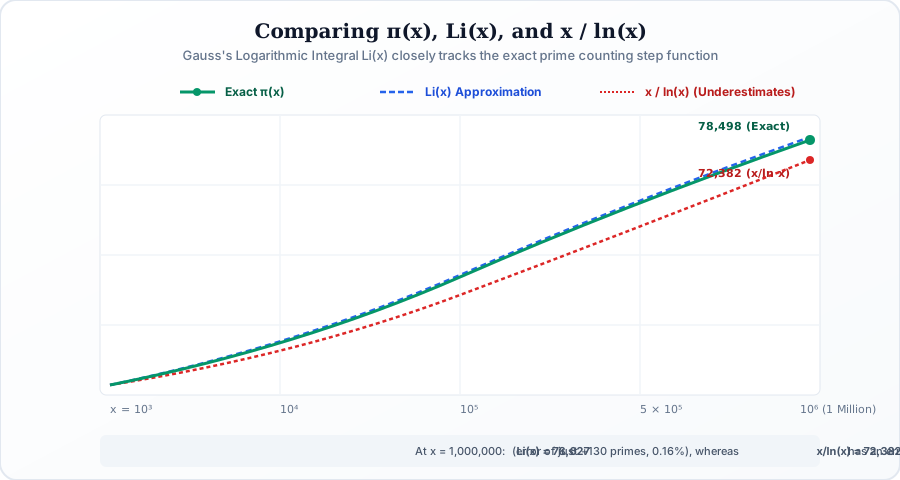
Look at how well they stack up at x = 1,000,000 (one million):
- Actual number of primes:
78,498 - Gauss’s smooth curve (
Li):78,628(off by only+130primes, or0.17%!) - Simple
x / ln(x)guess:72,382(off by−6,116primes, or7.79%)
The smooth curve is nearly 50 times closer!
4. How Primes Thin Out as Numbers Grow
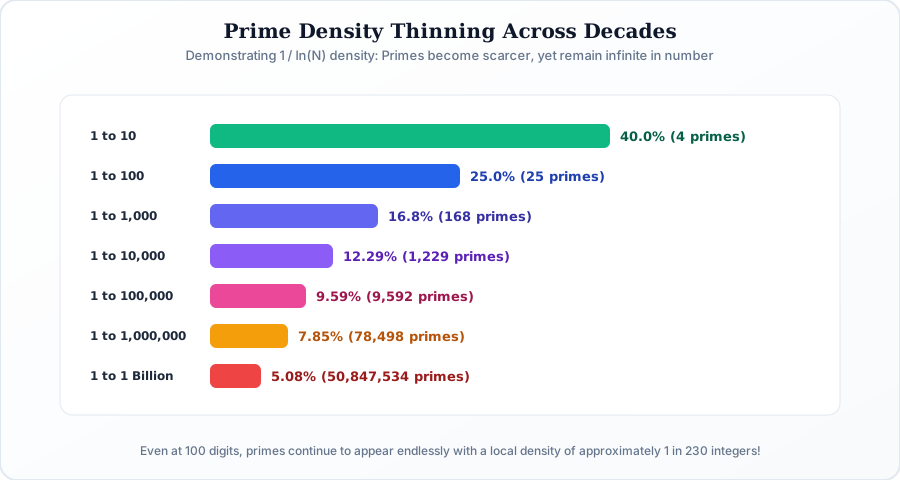
Does the share of prime numbers shrink as you count higher? Yes—but very slowly! About 1 in ln(N) numbers near N is prime:
| Number Range | Average Gap (ln N) |
Guess (1 / ln N) |
Exact Primes Found | Real Prime Share |
|---|---|---|---|---|
1 to 10 |
2.30 |
43.4% |
4 |
40.0% |
1 to 100 |
4.61 |
21.7% |
25 |
25.0% |
1 to 1,000 |
6.91 |
14.5% |
168 |
16.8% |
1 to 10,000 |
9.21 |
10.9% |
1,229 |
12.3% |
1 to 100,000 |
11.51 |
8.7% |
9,592 |
9.6% |
1 to 1,000,000 |
13.82 |
7.2% |
78,498 |
7.8% |
1 to 1,000,000,000 |
20.72 |
4.8% |
50,847,534 |
5.1% |
Notice something cool: between 1 and 100, 1 in 4 numbers is prime (25%). Up at 1 billion, primes are still 1 in 20 (5.1%)! They thin out gradually, yet never run dry—ancient Greek proofs showed there are endlessly many primes.
5. The Million-Dollar Mystery (The Riemann Hypothesis)
If Li(x) tracks the overall curve so cleanly, what causes the tiny back-and-forth wiggles between the smooth guess and the exact staircase π(x)?
In 1859, Bernhard Riemann made a stunning discovery: you can picture those tiny wiggles like sound waves layered on top of each other—sometimes nicknamed “the music of the primes.”
Riemann tied all those waves to special balance points of a formula called the Riemann zeta function. He guessed that every single one of those hidden balance points lines up straight down one vertical center line (at 1/2)—never drifting off to the left or right.
If Riemann’s guess (the Riemann Hypothesis, still unsolved today with a $1 million prize!) is right, it guarantees that prime numbers never clump wildly off track—they stay as evenly spaced as mathematically possible forever.
6. Benchmark Table: True Counts vs. Smooth Estimates
Compare real prime counts all the way up to 1 quintillion (10¹⁸) against Gauss’s Li curve:
Limit (x) |
True Primes π(x) |
Smooth Curve Guess Li(x) |
Difference (Li − π) |
Percent Error |
|---|---|---|---|---|
1,000 (10³) |
168 |
178 |
+10 |
5.95% |
1,000,000 (10⁶) |
78,498 |
78,628 |
+130 |
0.17% |
1,000,000,000 (10⁹) |
50,847,534 |
50,849,235 |
+1,701 |
0.0033% |
10¹² (1 Trillion) |
37,607,912,018 |
37,607,950,281 |
+38,263 |
0.0001% |
10¹⁵ (1 Quadrillion) |
29,844,570,422,669 |
29,844,571,475,287 |
+1,052,618 |
0.0000035% |
10¹⁸ (1 Quintillion) |
24,739,954,287,740,860 |
24,739,954,309,690,743 |
+21,949,883 |
0.000000089% |
Notice how Li(x) sits slightly above π(x) in every single row above! For decades, people wondered if π(x) could ever pass Li(x). Then in 1914, J. E. Littlewood proved they actually cross back and forth infinitely many times—though the very first crossing happens at an unimaginably huge number (far more digits than atoms in the universe!).
Quick Questions & Answers
What does the Prime Number Theorem say in plain words?
It says that up to any large number x, roughly 1 out of every ln(x) numbers is prime—so the total count of primes is close to x / ln(x).
How is π(x) different from π = 3.14159...?
They have nothing to do with circles! Mathematicians simply borrowed the Greek letter π (for prime) to stand for “how many primes exist up to x.”
How can I guess the 1,000,000th prime without counting all of them?
Flip the estimate around: the n-th prime sits near n × ln(n). For n = 1,000,000, 1,000,000 × 13.816 ≈ 13,815,510. The real 1,000,000th prime is 15,485,863—right in the ballpark!
Interactive Tools to Try
- Compare estimates against real prime counts: Prime Number Theorem Calculator
- Count exact primes up to any limit: Prime Counting Calculator
- Jump directly to any rank like the 1,000th prime: Nth Prime Calculator
- Spot visual patterns in primes: Prime Distribution & Ulam Spiral
Want to check a prime number right now?
Our free online calculator checks numbers up to 18 quintillion with 100% accuracy, giving you instant factor trees and clear step-by-step reasons.
Written in plain, friendly English and checked against trusted math research and automated tests.