Prime Factorization Calculator
Break any whole number into its prime building blocks with step-by-step division ladders, powers, factor pairs, and factor counts.
Step-by-Step Division Ladder
Dividing by smallest primesAll Factor Pairs
1. The Prime Building Blocks Rule
A fundamental rule of arithmetic states that every whole number greater than 1 is either a prime itself or can be multiplied together from a unique set of prime numbers:
Just as chemical molecules are built from specific atoms, every number in mathematics is built from its own unique combination of prime numbers.
Interactive Number Builder
Try It LiveAdjust how many 2s, 3s, and 5s to multiply together to see how composite numbers are built:
2. Proper Factors & Number Chains
A number's proper factors are all of its divisors except the number itself. If their sum equals the number, it is called a perfect number (like 6 or 28). If the sum is greater, it is called abundant. You can follow where these sums lead step-by-step:
Factor Sum & Chain Explorer
Sum of factors (excluding n)Enter any whole number up to 50,000 to see its factors and follow its 5-step chain:
3. Famous Numbers & Their Prime Factors
20 landmark numbers from geometry, computing, and mathematics. Click "Factorize" to test any row:
| Number (n) | Prime Factors | Total Factors | Sum of Factors | Category | Action |
|---|---|---|---|---|---|
| 12 | 2² × 3 | 6 | 28 | Small Composite | |
| 24 | 2³ × 3 | 8 | 60 | Many Factors | |
| 28 | 2² × 7 | 6 | 56 | Perfect Number | |
| 30 | 2 × 3 × 5 | 8 | 72 | Three Primes | |
| 60 | 2² × 3 × 5 | 12 | 168 | Clock & Geometry Base | |
| 120 | 2³ × 3 × 5 | 16 | 360 | 5 Factorial (5!) | |
| 210 | 2 × 3 × 5 × 7 | 16 | 576 | Four Primes | |
| 256 | 2⁸ | 9 | 511 | Computer Byte (2⁸) | |
| 360 | 2³ × 3² × 5 | 24 | 1,170 | Degrees in a Circle | |
| 496 | 2⁴ × 31 | 10 | 992 | Perfect Number | |
| 504 | 2³ × 3² × 7 | 24 | 1,560 | Consecutive Numbers | |
| 720 | 2⁴ × 3² × 5 | 30 | 2,418 | 6 Factorial (6!) | |
| 1,000 | 2³ × 5³ | 16 | 2,340 | Base 10 (10³) | |
| 1,024 | 2¹⁰ | 11 | 2,047 | 1 Kilobyte (2¹⁰) | |
| 2,310 | 2 × 3 × 5 × 7 × 11 | 32 | 6,912 | Five Primes | |
| 2,520 | 2³ × 3² × 5 × 7 | 48 | 9,360 | Evenly Divisible 1-10 | |
| 5,040 | 2⁴ × 3² × 5 × 7 | 60 | 19,344 | 7 Factorial (7!) | |
| 8,128 | 2⁶ × 127 | 14 | 16,256 | Perfect Number | |
| 30,030 | 2 × 3 × 5 × 7 × 11 × 13 | 64 | 96,768 | Six Primes | |
| 65,536 | 2¹⁶ | 17 | 131,071 | 16-Bit Word (2¹⁶) |
4. How to Calculate Total Factors from Exponents
You don't need to count every single factor by hand. Once a number is broken down into prime powers, simple math formulas give you the totals directly:
This simple shortcut saves time, especially for large numbers with dozens of divisors.
5. Step-by-Step Examples
360 is even: divide by 2 → 180, /2 → 90, /2 → 45. Divide by 3 → 15, /3 → 5. Divide by 5 → 1. All prime building blocks: 2³ × 3² × 5¹. Total factors: (3+1)(2+1)(1+1) = 24.
1,024 is 2 raised to the 10th power. Dividing repeatedly by 2 takes exactly 10 steps down to 1. Total factors: (10 + 1) = 11 factors (all powers of 2).
Multiplying the first 5 primes: 2 × 3 × 5 × 7 × 11. Because every prime appears only once, it has 2⁵ = 32 distinct factors.
982,081 has no small factors under 900. Testing primes leads to 991: 982,081 ÷ 991 = 991. Thus, 982,081 = 991² with exactly 3 factors (1, 991, and 982,081).
6. Why Factoring Matters in the Real World
Global online banking and secure websites rely on prime factoring being easy in one direction (multiplying two primes) and practically impossible in reverse (finding the two primes from a massive product).
Fast processing algorithms for audio, streaming video, and medical imaging work best with data sizes that factor cleanly into powers of 2, 3, or 5.
Solid-state drives and operating systems group memory into powers of 2 (such as 4,096 bytes = 2¹²), ensuring speed and preventing wasted memory space.
Casio scientific calculators include a built-in FACT command (press [SHIFT] then [FACT]) that runs factorization hardware chips directly inside the calculator.
7. How Computers Factor Numbers
| Method | Speed | Memory | How It Works | Best Used For |
|---|---|---|---|---|
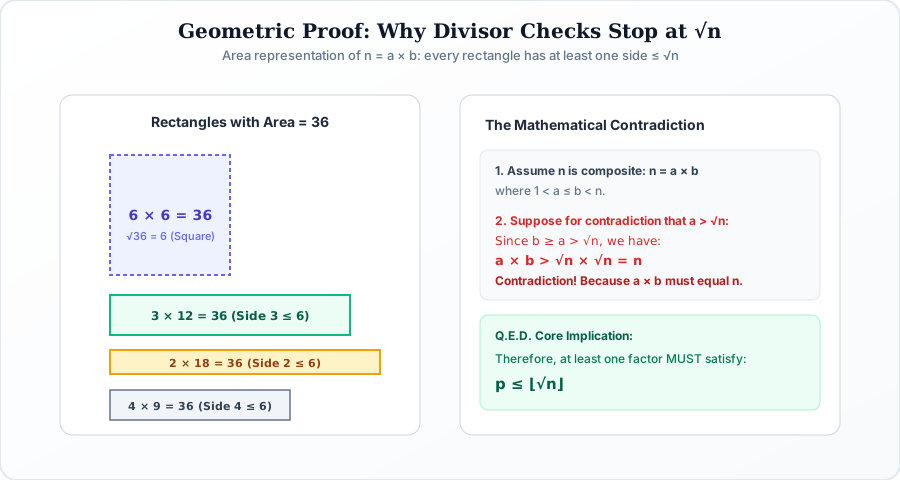
| Step-by-Step Division (Our Engine) | Fast | None | Tests primes step-by-step up to √n | Numbers up to 1 trillion |
| Fermat's Method | Very Fast | None | Uses difference of squares (a² - b²) | Numbers with two close factors |
| Looping Shortcut (Pollard's Rho) | Extremely Fast | Very low | Spots repeating loops to catch shared factors | Numbers up to 18 digits |
| Number Field Sieve | Supercomputer scale | High | Advanced algebra on clusters | Numbers with over 100 digits |
Related Factor & Prime Tools
Frequently Asked Questions
What is prime factorization?
Prime factorization means breaking a whole number down into prime numbers that multiply together to make it. For example, the prime factors of 12 are 2 × 2 × 3 (or 2² × 3). A key rule of mathematics (the Fundamental Theorem of Arithmetic) states that every whole number greater than 1 has only one unique set of prime building blocks.
Why doesn't the number 1 have a prime factorization?
The number 1 is neither prime nor composite. Because a prime number must have exactly two distinct factors (1 and itself), 1 does not qualify. Therefore, 1 cannot be broken down into prime factors.
What is the difference between a division ladder and a factor tree?
Both methods give you the exact same prime factors. A division ladder divides out the smallest primes (like 2, 3, 5) step-by-step downwards until you reach 1. A factor tree splits the number into any two factors you can think of, then keeps branching until only prime numbers are left on the tips.
How do you find the total number of factors from prime powers?
Once you have the prime factors written with exponents, add 1 to each exponent and multiply those numbers together. For example, 360 = 2³ × 3² × 5¹. Adding 1 to each exponent gives 4, 3, and 2. Multiplying them (4 × 3 × 2) gives 24 total factors!
How do you factor numbers on a Casio scientific calculator?
On supported Casio calculators (like the fx-991EX ClassWiz or fx-991CW), enter your number, press [=], then press [SHIFT] and the [FACT] button (above the degree symbol). The screen will display the prime factors with exponents.
Why is factoring large numbers important for computer security?
Multiplying two large prime numbers together is fast and easy for computers, but reversing the process (factoring a huge number back into its two original primes) takes standard supercomputers millions of years. This one-way math trick protects banking, passwords, and private messages online.
How large of a number can this calculator factor?
Our calculator factors numbers up to 1 trillion instantly in your browser using step-by-step division, with clear work shown. For larger numbers up to 18 quintillion, it confirms prime factors with 100% mathematical certainty.