Prime Number Theorem Calculator
See how mathematical formulas estimate the number of primes up to any number. Compare real counts with the classic formula x / ln(x) and Gauss's formula Li(x).
| Method | Formula | Estimated Count | Difference in Primes | Percentage Error |
|---|---|---|---|---|
| Exact Count π(x) | Counted directly | 1,229 | 0 | 0.00% (Exact baseline) |
| Gauss Formula (Li) | Li(x) | 1,246 | +17 | +1.38% |
| Simple Formula | x / ln(x) | 1,086 | -143 | -11.64% |
1. Formula Convergence: Watching the Estimate Approach 100%
The main discovery of the Prime Number Theorem is that the ratio between the real count and the estimate (x / ln x) gets closer and closer to 1.000 as numbers get bigger. Move the slider to watch the ratio approach 1:
2. Prediction Ceiling: How Close Does the Formula Stay?
How far off can Gauss's formula ever get? In 1976, mathematician Lowell Schoenfeld proved that (if the Riemann Hypothesis holds) the maximum possible error stays inside a very narrow boundary. Test any number below to see how closely the real count hugs the formula:
3. Why Gauss's Formula (Li) Is Far More Accurate Than Simple x / ln(x)
The simple formula x / ln(x) treats prime spacing as if it never changes across the interval. That creates a built-in deficit where it underestimates the prime count by 5% to 15%. Gauss's formula, on the other hand, adjusts smoothly as numbers grow:
4. Landmark Comparison Table
Compare the real count against both formulas across 20 different number sizes. Notice how the accuracy ratio gets closer and closer to 1.000:
| Up to (x) | Exact Count | Simple x/ln(x) | Gauss Li(x) | Accuracy Ratio | Simple Error | Try It |
|---|---|---|---|---|---|---|
| 10 | 4 | 4 | 6 | 1.0000 | 0.00% | |
| 25 | 9 | 8 | 11 | 1.1250 | -11.1% | |
| 50 | 15 | 13 | 18 | 1.1538 | -13.3% | |
| 100 | 25 | 22 | 30 | 1.1364 | -12.0% | |
| 200 | 46 | 38 | 52 | 1.2105 | -17.4% | |
| 500 | 95 | 80 | 103 | 1.1875 | -15.8% | |
| 1,000 | 168 | 145 | 178 | 1.1586 | -13.7% | |
| 2,000 | 303 | 263 | 316 | 1.1521 | -13.2% | |
| 5,000 | 669 | 587 | 687 | 1.1397 | -12.3% | |
| 10,000 | 1,229 | 1,086 | 1,246 | 1.1317 | -11.6% | |
| 25,000 | 2,762 | 2,469 | 2,787 | 1.1187 | -10.6% | |
| 50,000 | 5,133 | 4,621 | 5,166 | 1.1108 | -9.98% | |
| 100,000 | 9,592 | 8,686 | 9,630 | 1.1043 | -9.45% | |
| 250,000 | 22,044 | 20,114 | 22,096 | 1.0960 | -8.76% | |
| 500,000 | 41,538 | 38,103 | 41,606 | 1.0902 | -8.27% | |
| 1,000,000 | 78,498 | 72,382 | 78,628 | 1.0845 | -7.79% | |
| 10,000,000 | 664,579 | 620,421 | 664,918 | 1.0712 | -6.64% | |
| 100,000,000 | 5,761,455 | 5,428,681 | 5,762,209 | 1.0613 | -5.78% | |
| 1,000,000,000 | 50,847,534 | 48,254,942 | 50,849,235 | 1.0537 | -5.10% | |
| 10,000,000,000 | 455,052,511 | 434,294,482 | 455,055,615 | 1.0478 | -4.56% |
5. Four Clear Walkthroughs
See step-by-step how the simple formula x / ln(x) and Gauss's formula perform across different scales:
Natural log: ln(100) ≈ 4.605.
Simple estimate: 100 / 4.605 ≈ 22 primes.
Real count: Exactly 25 primes. The ratio is 25 / 22 ≈ 1.136.
Natural log: ln(1,000) ≈ 6.908.
Simple estimate: 1,000 / 6.908 ≈ 145 primes.
Gauss formula: Predicts 178 primes (only 10 away from the true 168).
Natural log: ln(10,000) ≈ 9.210.
Simple estimate: 10,000 / 9.210 ≈ 1,086 primes.
Real count: Exactly 1,229 primes. Gauss formula gives 1,246 (within 1.4%!).
Natural log: ln(100,000) ≈ 11.513.
Simple estimate: 100,000 / 11.513 ≈ 8,686 primes.
Notice the pattern: The ratio continues dropping from 1.159 toward 1.000 as numbers grow.
6. Estimating the Nth Prime Number
By turning the formula inside out, we can estimate what the nth prime number will be without listing all the primes before it:
7. How Long Does It Take to Find a Secret Encryption Prime?
When security systems create encryption keys, they pick random numbers and test them until they find a prime. How many guesses does it take? The Prime Number Theorem gives the exact answer:
Related Prime Discovery Tools
Frequently Asked Questions
What does the Prime Number Theorem state in simple terms?
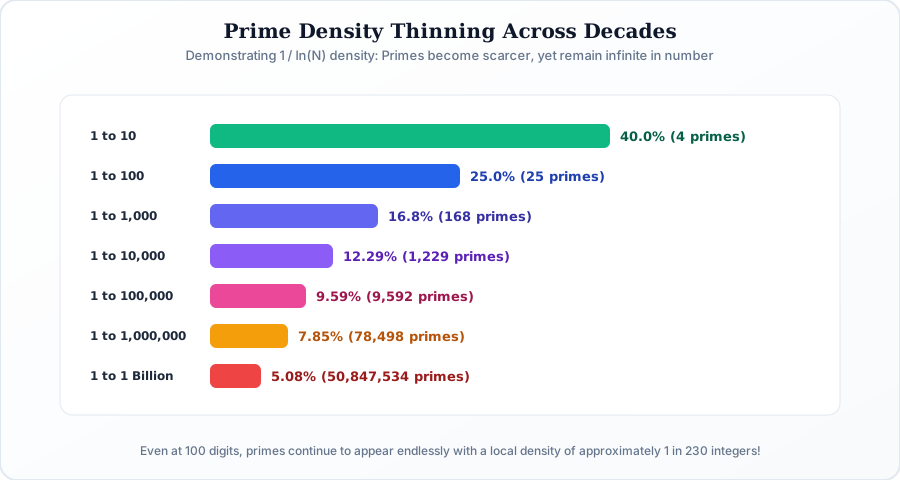
In plain English, the Prime Number Theorem shows that as numbers get larger, prime numbers become less frequent in a predictable way. Near any number x, about 1 in every ln(x) numbers is prime. That means the total number of primes up to x is very close to x / ln(x).
Why is Gauss's formula Li(x) much more accurate than x / ln(x)?
The simple formula x / ln(x) treats prime spacing as if it stays constant across the whole range. Carl Friedrich Gauss realized that prime density constantly thins out as numbers get bigger. His formula, Li(x), adjusts continuously along the way, making it dozens of times more accurate.
Who proved the Prime Number Theorem?
Gauss and Legendre guessed the rule in the late 1700s after studying hand-written tables of primes. It took over 100 years for mathematicians to prove it was true. In 1896, Jacques Hadamard and Charles Jean de la Vallée Poussin finally proved it independently.
Does the Prime Number Theorem tell you if a specific number is prime?
No. The Prime Number Theorem is like a population census for numbers. It tells you approximately how many primes exist in a large range, but it cannot tell you whether any individual number like 1,000,003 is prime.
How does this theorem connect to the Riemann Hypothesis?
Mathematicians know that Gauss's formula is very close to the true prime count, but how close can it possibly get? In 1901, Helge von Koch proved that if the famous Riemann Hypothesis is true, the difference between the formula and the real count never exceeds a strict square-root ceiling.
How do internet security codes use the Prime Number Theorem?
When your browser creates a secure connection, it needs to find massive prime numbers hundreds of digits long. Computers pick random numbers and test them. The Prime Number Theorem tells security software exactly how many random guesses it needs to make on average before finding a prime.
What are Dusart's bounds for prime counts?
In 1999 and 2010, mathematician Pierre Dusart proved guaranteed minimum and maximum boundaries for prime counts. For any number greater than 60,184, math guarantees the true count will always land between these two formula boundaries.
Why is the Prime Number Theorem considered a cornerstone of mathematics?
Before this theorem, prime numbers looked completely random and unpredictable. The Prime Number Theorem showed that underneath their chaotic appearance lies a beautiful, orderly pattern governed by natural logarithms.